I’m a Menstrual Wellness Practitioner, Children’s Mental Health advocate, Eating Disorder specialist, and Designated Safeguarding Lead, with a lifelong passion for supporting young people.
Alongside this, I’ve spent over 20 years in sport as a qualified Gymnastics and Trampoline Coach, working closely with young people throughout my entire adult life. I love creating spaces where young people feel heard, understood, and confident to share their perspectives.
I am also actively involved in grassroots sport and currently volunteer as the Female Liaison Officer at Fulledge Colts Football Club, where I support the development, inclusion and wellbeing of girls within the club. My role focuses on breaking down barriers that often cause girls to disengage from sport — including confidence, body image, and menstrual health — helping them to stay involved, feel supported, and thrive.

Alongside this, I work closely with sports clubs and organisations across a range of disciplines to embed menstrual wellbeing into their environments. This includes football, gymnastics, netball and beyond, supporting initiatives such as British Gymnastics She Leaps programme and NetballHer. Through these partnerships, I help clubs better understand and support female athletes, creating inclusive spaces where girls can stay in sport for longer.
The Period Coach is an empowering community project born from Burnley Enterprise of Sport and Training CIC. My husband and I previously founded The BEST Centre, a family-run facility with over 500 members, 90% of whom were girls. Together, we created a space that inspired girls to participate in sport, build confidence, and develop leadership skills.
We later passed this legacy on to Nile Wilson, who continues to grow its impact today.
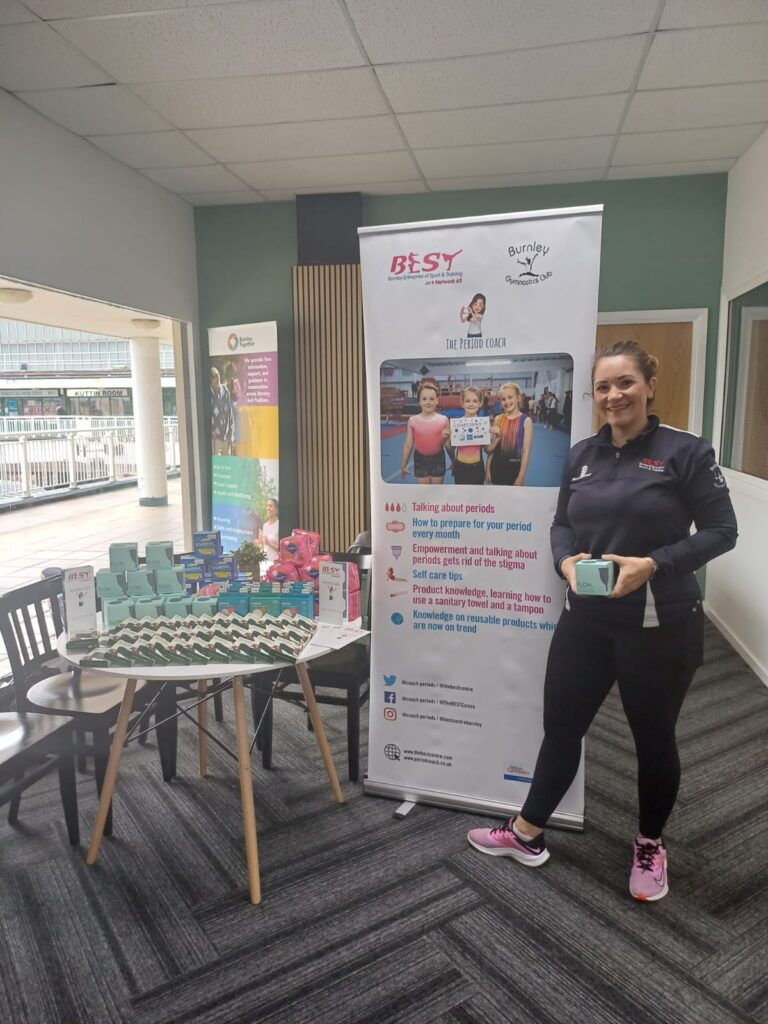
Our work has been recognised and supported through funding from Sport England, The National Lottery, Burnley Council, and Lancashire Health Visiting and School Nursing teams, enabling us to reach more young people and remove barriers to participation. To date, we have supported young people with over 100,000 period kits, helping to break down barriers to education and sport.
Now, our focus is on school and community outreach, delivering menstrual and mental health education to break down stigma, build confidence, and remove barriers to participation.
Our mission is simple: to increase female participation in sport across Lancashire by ensuring every young person feels supported, informed, and empowered.
The inception of The Period Coach coincided with the onset of COVID-19 – a time that brought unprecedented challenges for us all. Our gym was forced to close for an extended period, and like many others, we adapted quickly, supporting our gymnasts and members to train from home over Zoom (and yes, we all became very familiar with a Zoom call!).
When we were finally able to reopen briefly between lockdowns, we noticed something significant. Many of our young people had started their periods during that time away – and quietly, many were not returning to sport.
For generations, conversations around menstruation have been surrounded by discomfort, silence and stigma. Young people are often left to navigate this completely natural part of life on their own, with little guidance at home, in school, or within their peer groups. This lack of open conversation impacts confidence, wellbeing, and participation – contributing to wider issues such as period poverty and disengagement from sport.
It has never been more important to change that.
Despite growing awareness, stigma and misinformation still shape the lived experiences of many young people. Without education and support, menstruation becomes a barrier – one that quietly removes young people from opportunities to build confidence, stay active, and feel part of a community.
Research from Plan International UK highlights the scale of this challenge, with many young people avoiding sport during their period due to embarrassment, lack of support, or limited understanding of their cycle. Before the pandemic, 1 in 10 young people experienced period poverty, rising significantly during lockdown — and with the ongoing cost of living crisis, access to period products remains a real challenge for many families.
Recognising the need for change, we began by listening. We reached out to our gymnasts and their families, creating safe spaces for open, honest conversations. Time and time again, the same themes emerged — silence, shame, and a lack of understanding.
From those conversations, something powerful happened.
By opening up the dialogue and providing access to education and practical support, we began to see young people return – not only to sport, but with renewed confidence. They brought their friends, shared their experiences, and became part of a more open and supportive environment. It became clear that when young people are given the knowledge and space to understand their bodies, barriers begin to fall.
From this, The Period Coach was born – shaped not only by professional experience, but by lived experience, deepening our understanding of the barriers young people face.
What started as a response to a moment in time has grown into a movement across schools, communities and sport. To date, we have supported young people with over 100,000 period kits, alongside delivering education through school workshops and partnerships with local organisations, helping to break down stigma and remove barriers to participation.
As our work has grown, so too have the conversations – thoughtful, honest, and often challenging – around what period poverty really means, and the misconceptions that still exist.
A question I am often asked is: What does period poverty mean to you? To me, period poverty means an individual either cannot afford period products due to financial constraints, does not know how to use them, or has never received adequate education or guidance about menstruation—or sometimes all of these factors combined. There is nothing to be ashamed of.
Another frequent question is: What is the biggest misconception about periods? The most significant misconception about period poverty is that many do not recognise it as a basic right to have access to period products, but rather see it as a right to continue living life despite experiencing debilitating PMS, painful periods and periods in general. That’s why The Period Coach utilises sport to deliver workshops that inspire young people not to give up.